|
Turkey & Holy Land Cruise November 9th to December 3rd, 2013 |
|
|
|||||||||||||||||||||||||||||||||||||||||||||||
|
|||||||||||||||||||||||||||||||||||||||||||||||
|
The ship repositioned overnight 130 km (80 miles) north to the port of Haifa, sailing past Tel Aviv at some point through the night. At 7:40 we exited the ship with no issues with no crowds to fight our way through. Our shore passes to Israel were still good from yesterday so we just walked off. While still on the gangway we spotted Avi already waiting for us so it was right into the van and out of the port. After a brief stop at a lookout-point we continued on to our first tour stop of the day.      click picture to enlarge The Stella Maris Monastery is a Catholic Christian monastery for Discalced Carmelite monks located on the slopes of Mount Carmel in Haifa. The main church inside the Stella Maris Monastery is said to contain the Cave of Elijah, a grotto associated with the Biblical prophet Elijah. After a short visit, it was back to the minivan to continue our drive to Mt. Carmel.    click picture to enlarge The Baháʼí Terraces, or the Hanging Gardens of Haifa, are garden terraces on Mount Carmel. Completed in 2001, there are 19 terraces and more than 1,500 steps ascending the mountain. The terraces represent the first eighteen disciples of the Báb, who were designated "Letters of the Living", although no terraces are connected with particular individuals. The central terrace or Louis Prominade has the Shrine of the Báb, one of the main religious sites of the Baháʼí Faith. The terraces are part of a complex of Baháʼí holy places in Haifa, Acre, and western Galilee that were inscribed as a UNESCO World Heritage Sites.           click picture to enlarge From Mt. Carmel, we dead-headed to Nazareth, 50 km (30 miles) to the east. Our destination was the Church of the Annunciation or the Basilica of the Annunciation which is a Catholic church in Nazareth in the Galilee. It’s the site of the Annunciation in which the angel Gabriel appeared to the Virgin Mary and announced that she would give birth to Jesus. The upper level contains a number of images of Mary, mainly mosaics, each from a different country. Behind the main altar is a huge mosaic, one of the biggest in the world, depicting the “one, holy, catholic and apostolic church”. The lower level contains the Grotto of the Annunciation, believed to be the remains of the original childhood home of Mary. The Church of St Joseph in Nazareth is built over the carpentry workshop of the husband of the Virgin Mary. The church (also known as the Church of the Nutrition and the Church of Joseph’s Workshop) stands in the shadow of the soaring cupola of the Church of the Annunciation on its southern side.                     click picture to enlarge Into the minivan once again we continued east through Tiberias, the capital of Galilee founded by the son of Herod, then north along the shoreline of the Sea of Galilee towards The Mount of Beatitudes. Along the way we passed a Sea of Galilee Sea Level sign on the road that indicates the Sea of Galilee lies 212 meters below sea level at that point. Interesting if nothing else. The Mount of Beatitudes is a hill in northern Israel, which is the site of Jesus' Sermon on the Mount. Its negative altitude (around 25 metres below sea level, nearly 200 metres above the Sea of Galilee) makes it one of the lowest summits of the world. A Byzantine church was erected lower down the slope from the current site in the 4th century, and it was used until the 7th century. Remains of a cistern and a monastery are still visible. The current Roman Catholic Franciscan chapel was built in 1937-38.                 click picture to enlarge From there it was down to the Church of the Multiplication of the Loaves and Fish. This is a Roman Catholic church located at Tabgha, on the northwest shore of the Sea of Galilee. The church marks the site where Jesus performed the miracle of the multiplication of loaves and fish. This was also the site where Jesus appeared for the fourth time after his resurrection. The modern church rests on the site of two earlier churches.    click picture to enlarge On to Capernaum, the village Jesus lived in for 2 years during his ministry. One house in Capernaum was venerated as the house of Peter the fisherman. Two churches have been constructed over it. In the interior is a modern memorial built over the house of St Peter. The Capernaum Synagogue, also known as the White Synagogue, is a fourth century Jewish temple built on the remains of an earlier first century synagogue. There is another first century building underneath it, which is believed to be the actual synagogue of Capernaum where Jesus preached and it may have been the center of his activities.              click picture to enlarge From Capernaum we traveled to the River Jorden, where according to tradition, Jesus was baptized by John the Baptist. Yardenit is situated on the banks of the river and offers a setting for those wishing to baptize in the River Jordan. Deciding not to be re-baptised, I opted instead to wade in on steps leading into the water, where hundreds of catfish swarmed my feet.       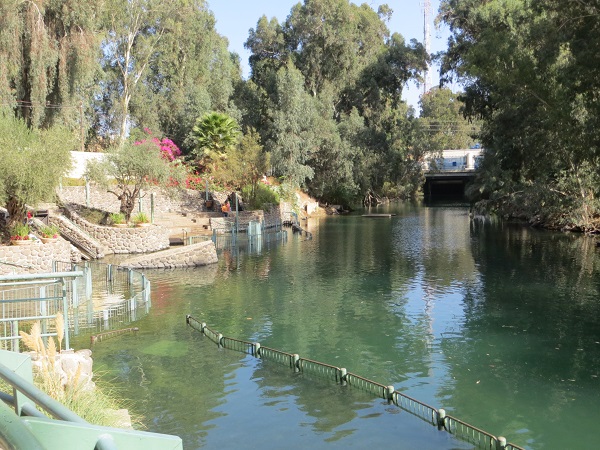    click picture to enlarge It was now getting to be late in the day and we had one more destination planned before returning to the ship. The Golan Heights is a hilly area overlooking the upper Jordan River valley to the west. The area was part of extreme southwestern Syria until 1967, when it came under Israeli military occupation, and in December 1981 Israel unilaterally annexed the part of the Golan it held. The eastern third remains under the control of Syria. The area’s name is from the biblical city of refuge Golan in Bashan. The heights give Israel an excellent vantage point for monitoring Syrian movements. The topography provides a natural buffer against any military thrust from Syria. There are more than 30 Israeli settlements (kibbutz) in the Golan, which are home to an estimated 20,000 people. The settlements are considered illegal under international law, although Israel disputes this. The entire area is obviously an active military zone. The tension was felt throughout our traverse of it, especially at Hamat Gader where the borders of Syria, Jordan and Israel meet.            click picture to enlarge Finally, it was time to conclude our touring and make tracks back to the port at Haifa where our ship and a welcome dinner awaited us. Other than a delay caused by an accident on the highway, we made good time. Arrived back to the ship at 5:30 a ½ hour late but no issue for us as the ship wasn’t departing until 8:30 tonight. We bid goodbye to our guide Ari, who provided us a full and fascinating two days of touring the Holy Land.     click picture to enlarge |
|||||||||||||||||||||||||||||||||||||||||||||||
|
|||||||||||||||||||||||||||||||||||||||||||||||
|
|
|||||||||||||||||||||||||||||||||||||||||||||||



